
In a fascinating discovery, scientists have found that elephants may call each other by name, adding to the growing list of human-like behaviors exhibited by these intelligent animals.
Researchers from Colorado State University (CSU) recorded 470 distinct sounds made by elephants in Kenya.
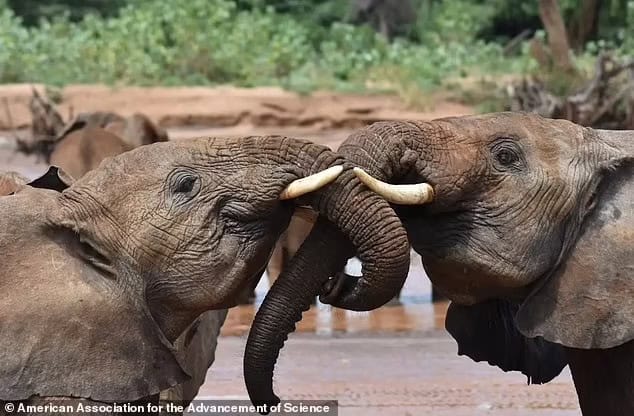
By analyzing these vocalizations, they discovered that elephants use specific rumbles or pitches when addressing one another, almost as if calling each other by name.
The research team tested their theory by playing the recorded calls back to the herds. They found that the elephant being “called” responded either by making a noise or moving towards the source of the sound, suggesting that elephants can recognize their names.

This discovery hints at elephants’ capacity for abstract thinking, revealing a deeper social complexity than previously understood.
Lead researcher Dr. Michael Pardo explained, “Dolphins and parrots use imitation to call each other by name, but our findings show that elephants don’t imitate the calls of the receiver. Instead, they use unique vocalizations, similar to how humans use names.”
Elephants are known for behaviors resembling human traits, including compassion, mourning, and using tools.

This latest research positions them alongside dolphins and parrots as one of the few species known to address individuals by name.
The study involved 101 elephants in Kenya’s Samburu National Reserve and Amboseli National Park over 14 months.
Using machine learning technology, researchers could differentiate the acoustic structures of the calls, confirming that elephants use distinct sounds to identify each other.

The calls conveyed a wealth of information, including the caller’s identity, age, sex, and emotional state.
When elephants heard their name, they responded energetically, but when played calls not directed at them, they didn’t react—indicating their recognition of specific sounds as their names.
Kurt Fristrup, a research scientist at CSU, said the team’s most intriguing finding was that elephants aren’t simply mimicking sounds but using unique sonic labels. This suggests the possibility of other kinds of labels or descriptors in their communication.

Elephants are known for being expressive animals, and their reactions during the study made it easy for researchers to observe their responses.
Dr. Pardo, now at Cornell University, noted that when elephants heard sounds not meant for them, they seemed momentarily confused but quickly moved on, much like humans might when hearing an unfamiliar call.
The study offers new insights into how communication might have evolved millions of years ago, driven by the need for family bonds and social structures.
Elephants use a variety of sounds to communicate, including low-frequency rumbles that humans cannot hear.
Co-author George Wittemyer of CSU added, “This research sheds light on the pressures from complex social interactions that likely drove the evolution of these abilities, much like in humans.”
Further research is needed to explore whether elephants use specific sounds to identify objects like food, water, or locations, potentially unlocking more mysteries about their communication.
Read more Elephant News.


